
Carbon Accounting

We help your company prepare for a more sustainable future by identifying, measuring, and managing its climate impacts. Carbon accounting provides a clear and reliable foundation for reducing emissions, communicating responsibly, and meeting stakeholder expectations now and in the years to come.

Measuring your carbon footprint gives you the insight to reduce emissions, cut costs, manage risks, meet stakeholder expectations, and turn sustainability into a concrete, strategic advantage.

Benefits of Taigawise’s carbon accounting service:

  • Carbon footprint calculations comply with the GHG Protocol and/or the ISO 14064 standard
  • The calculations include Scope 1 and 2, as well as Scope 3, depending on the customer’s needs
  • We use comprehensive and reliable databases, supplementing their emissions factors with our own when necessary
  • The calculations can be viewed on a user-firendly service platform
  • The calculations we perform can be verified if the client so desires
  • The calculations can be performed as a one-time service or repeated annually
Frequently Asked Questions About Carbon Footprinting

Calculating your carbon footprint offers more than just emission data: it provides tangible competitive advantages and supports sustainable growth, regardless of your organisation’s size or situation.

  • Data-driven decisions and cost efficiency

Carbon footprinting helps your organisation identify its hot spots, or the key emission sources, of which management often reduces costs and improves financial efficiency.

  • Sustainable competitive advantage

Measuring your carbon footprint makes your sustainability efforts visible, streamlines operations, and meets the growing environmental expectations of customers and markets.

  • Risk management and compliance

A carbon footprint calculation can be a prerequisite for new projects, business partnerships, or financing, as more and more customers, partners, and investors require verified sustainability efforts and emissions data.

  • Stronger brand and trust

Purposeful climate action communicates credible leadership in sustainability. It strengthens your brand and builds trust with customers and other stakeholders.

A carbon footprint is a measure of the greenhouse gas emissions caused by a company’s operations. It can also be calculated for specific products, services, or activities. Carbon footprints help organisations and individuals understand their climate impact and identify effective ways to reduce emissions. Typically, a footprint accounts for emissions over a year and includes the full life-cycle emissions (Scope 1, 2, and 3).

A company’s carbon footprint consists of greenhouse gas emissions generated directly or indirectly by its operations and value chain. These emissions are generally categorised into three scopes:

  • Scope 1 – Direct emissions: Emissions from company-owned sources, such as fuel used in company vehicles or emissions from on-site energy production.
  • Scope 2 – Indirect emissions from purchased energy: Emissions from the generation of purchased electricity, district heating, or cooling.
  • Scope 3 – Other indirect value chain emissions: Emissions from product and raw material manufacturing, logistics, employee commuting, waste management, and end-of-life impacts.

Do you need a carbon footprint calculation or support in this area?

Book a free consultation or get in touch with us!

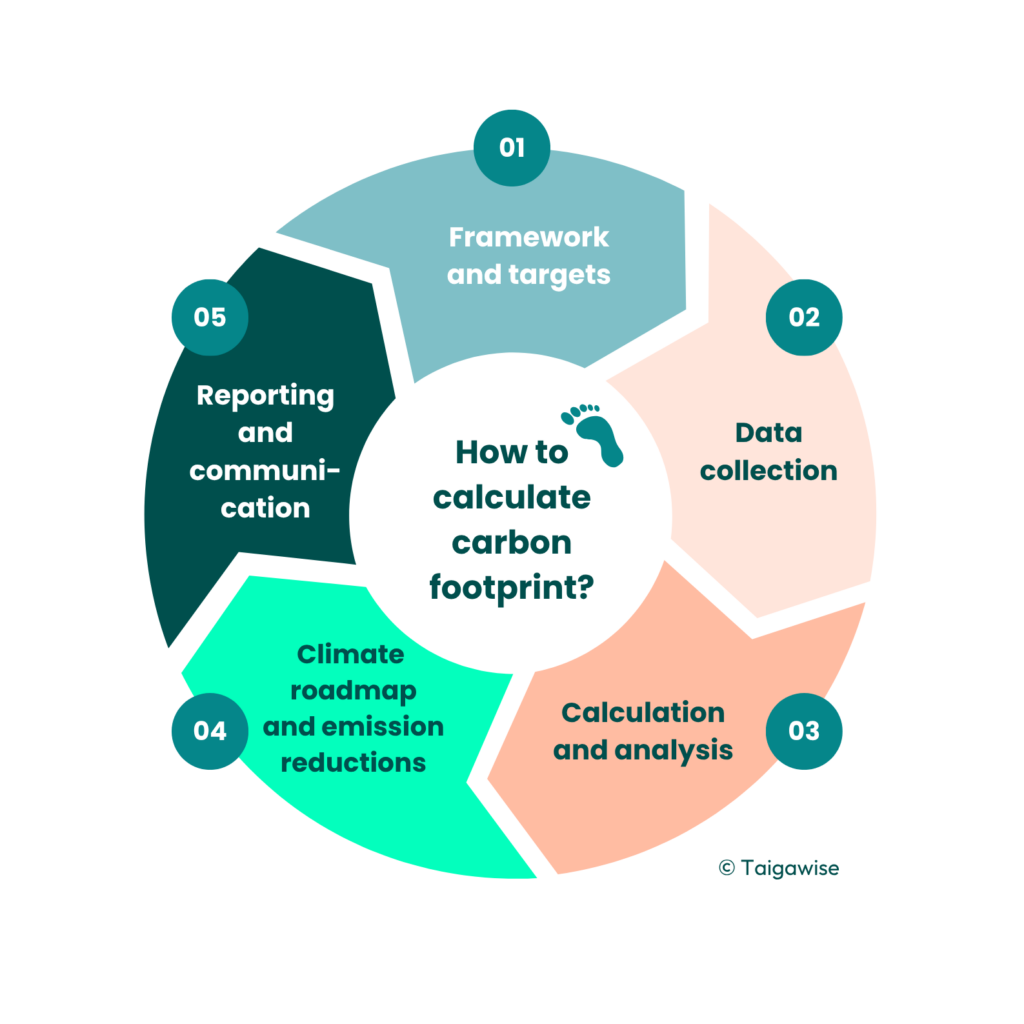
Carbon footprinting is a step-by-step process. First, the goals and boundaries of the calculation are defined, including which activities and emission sources are included. Next, consumption data is collected and validated for accuracy. These data are converted into greenhouse gas emissions using reliable emission factors in line with international standards. Analysis identifies the most significant emission sources and any limitations of the calculation.

To ensure the results lead to action rather than just numbers, they can be used to create a climate roadmap or a climate transition plan, including:

  • Short- and long-term emission reduction targets
  • Concrete actions to achieve these targets
  • Assessment of business changes impacting emissions
  • Monitoring plan to track emission trends over time

Finally, both the results and the climate roadmap are communicated to stakeholders. Carbon footprinting is often reported as part of broader sustainability reporting, but it can also be shared through other channels. The key is transparency about what has been done and what will be done.

Short answer: The sooner, the better.

There is no single “right” time to start. Any company can benefit now, regardless of the fiscal year, season, or operational schedule. The earlier you start, the easier it is to integrate emissions measurement into your business operations, reporting, and decision-making.

For example, autumn is an excellent time to begin calculating emissions for the current year. There is still ample time to collect necessary data and design an efficient process and responsibilities. A trial run using last year’s data can provide:

  • Benchmark data for comparing emission reductions and targets
  • Experience with the carbon accounting process, making the next cycle smoother and faster
  • Early insight into potential data gaps that can be addressed before formal reporting

Being carbon neutral means that your activities do not increase the concentration of greenhouse gases in the atmosphere. In practice, all emissions are first minimised as much as possible, and any remaining emissions are offset, for example by removing an equivalent amount of greenhouse gases from the atmosphere. Truly credible carbon neutrality relies on transparent accounting and primary emission reductions, not just offsets.

* indicates required

Tilaamalla uutiskirjeen hyväksyn, että syöttämäni tiedot tallennetaan Taigawisen asiakas- ja markkinointirekisteriin.

Voit peruuttaa tilauksesi milloin vain painamalla Peru tilaus-linkkiä sähköpostiemme alaosasta. Tietosuojaselosteemme löydät verkkosivuiltamme.

We use Mailchimp as our marketing platform. By clicking below to subscribe, you acknowledge that your information will be transferred to Mailchimp for processing. Learn more about Mailchimp’s privacy practices.

Intuit Mailchimp